
PAULA BRUNA
GENERAL INFO
- LOCATION
-
Institute for Postnatural Studies, Madrid
- DATE
-
Spring 2025
- TYPOLOGY
-
Residency - National
- ARTIST
-
Paula Bruna - Barcelona, Spain
SOFOCO: NATIONAL RESIDENCY
A six-week residency in Madrid (April–May 2025) for artists, journalists, researchers, or cultural agents based in Spain. The program explored the political and material implications of heat and global warming, presenting heat as a political subject in today's ecological debate. The residency supported work in writing, video, photo reportages, infographics, zines, interactive guides, radio, podcasts, social practices, pedagogy, or artistic mediation.
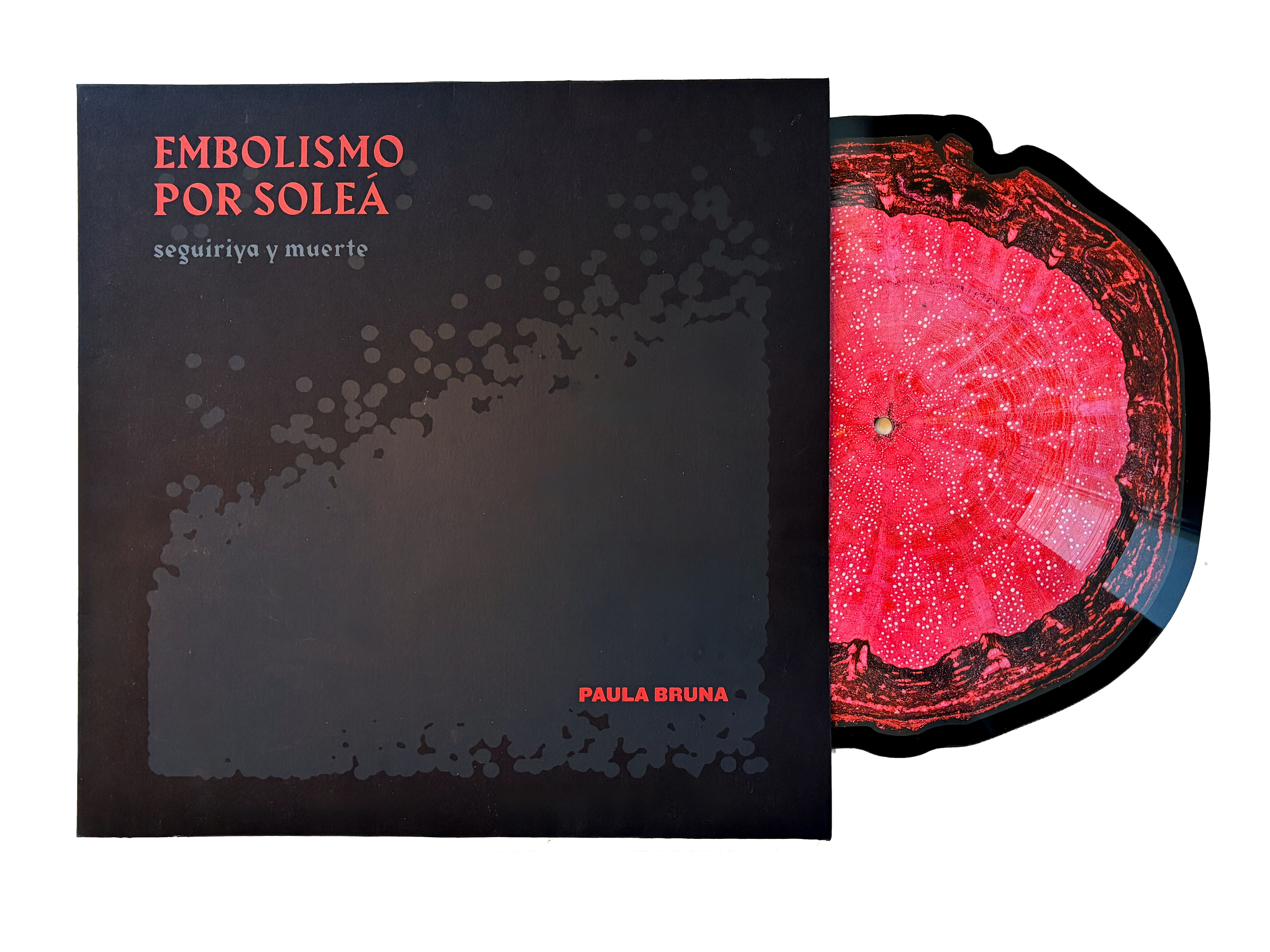
Embolismo por Soleá, Vynil. 2024
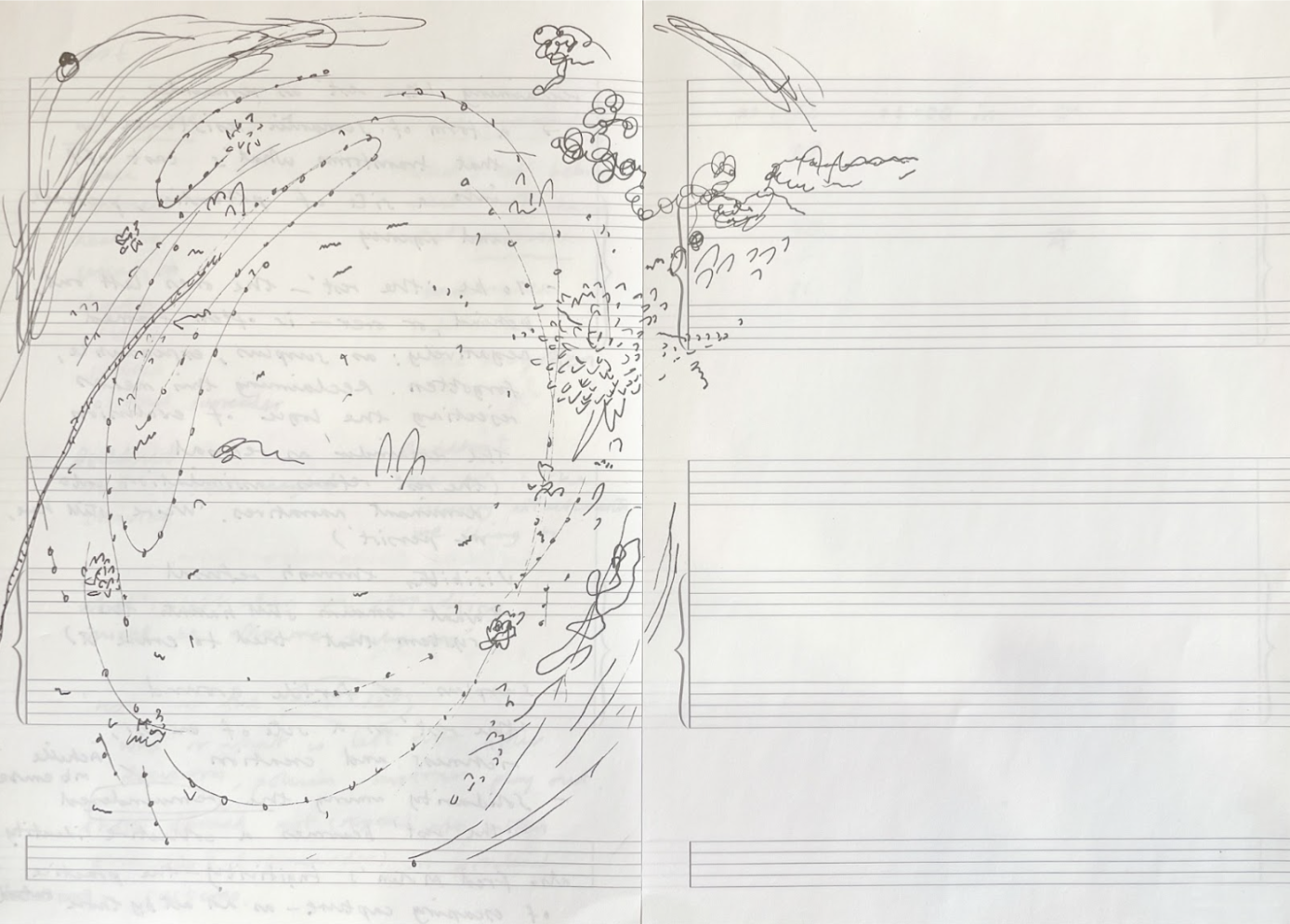
Paula Bruna’s project ‘Embolismo por soleá’, began with the study of vegetal embolism—the ultrasonic sound emitted by plants under drought stress—Paula interprets these acoustic recordings as a vegetal cante jondo, a deep lament that emerges from the innermost being of the plants, following a rhythm without compás (traditional flamenco meter). She works with ultrasound recordings from Iberian plants, exploring the sonority of forests, as well as the different choreographies that stem from the musicality of forests and plants’ internal drought.
SOFOTECA: mediatheque of suffocation.
The SOFOTECA is a multimedia archival space highlighting and revisiting the findings and learnings of the SOFOCO residency (Spanish for ‘suffocation’).
In April and May 2025, artist and environmental scientist Paula Bruna joined us from Barcelona with her long-term project ‘Embolismo por soleá’ which engaged in the study of vegetal embolism—the ultrasonic sound emitted by plants under drought stress. Paula interpreted these acoustic recordings as a vegetal cante jondo, a deep lament that emerges from the innermost being of the plants, following a rhythm without compás (traditional flamenco meter). She worked with ultrasound recordings from Iberian plants, exploring the sonority of forests, as well as the different choreographies that stem from the musicality of forests and plants’ internal drought. This led to rigorous research and a lively public program exploring the forest as a subject and site for postnatural flamenco-adjacent interspecies research.
Below, a bilingual essay in which Paula delves into her research, methods, discoveries and public program.

Cruel de Tucuman, 2021
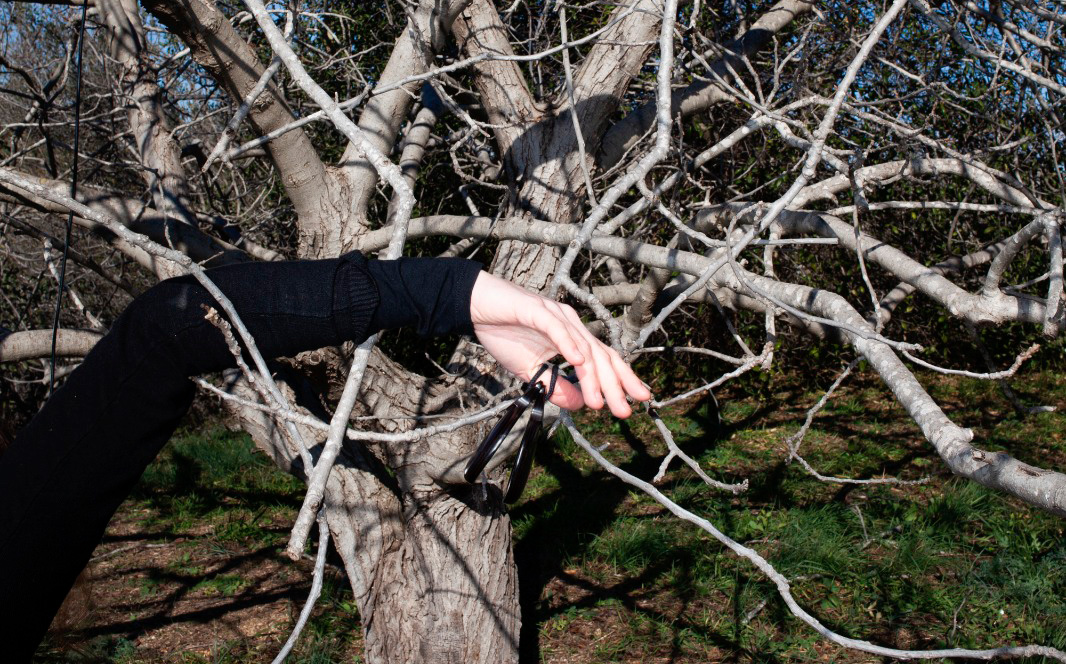
Embolismo por Soleá, Sound Recordings

Axial cross-sections of plant sample showing embolism. Source: Plant Methods
JONDO VEGETAL
Jondo vegetal
SOFOCO National Residency for Research and Multimedia Creation, 2025
Context
Heat increases plant water stress. In these circumstances, air bubbles form in the conductive vessels of plants and clog them. If the lack of water persists, the obstruction can extend through the xylem to the extent of being deadly to the plant. The formation of these air bubbles emits an ultrasound which is scientifically monitored to study how climate change affects forests. This is especially relevant in our latitudes, given that the typically dry periods of Mediterranean climate dangerously worsen under climate change. High temperatures and prolonged droughts can impair the water transport system of entire forests due to the accumulation of embolisms, or at least render them vulnerable to other threats such as pests or wildfires. However, not all species are equally sensitive. Studying embolism helps us understand how Mediterranean forests function, and which among them are more threatened by climate change.
Embolisms sound like palmas flamencas [flamenco claps]. From this vantage point, the sound associated with embolism is not only scientific data. It is also an expression of the spirit that comes from the depths of the plants, like the cante jondo [deep song] of a overheated forest.
There appears to be a mutual understanding between flamenco and trees, as if they shared a common root in the rhythms. We could pose that flamenco speaks ‘tree’ because it is imbued with it—both in language (the palos [flamenco styles], the flamenco tree, the lyrics of the songs which could very well be the trees’ quejíos [lamentations]) and materially (the heels, the castañuelas, the guitar, the cajón, the chair and the tablao [flamenco stage] are made of wood). Thus, flamenco knows the tree because it contains it. Hence, through flamenco, we can listen to what trees have to say about new climatic conditions. Flamenco is a mediator between humans and trees, a common language which, traversing more through emotion than logic, turns highly valuable for approaching the subjectivity of trees and for understanding, through them, the ecology that concerns us.
Besides all of this, flamenco is an excellent catalyst of eco-social change through the affirmation and collective celebration of life in all its aspects (joys, sorrows, and even death) and in all its forms. If yesteryear flamenco sheltered the minorities excluded by a dominant culture, now it offers a cultural space to mediate with living beings relegated to the margins of hegemonic anthropocentrism. For flamenco contains a universal language through which we are able to listen to the Earth and those who inhabit it. From this telluric origin, the duende has to do with the living spirit of the Earth, and the jondo (the deep) alludes to life beyond the human experience.
In this manner, the embolisms of trees are quejios flamencos [flamenco lamentations], just as I experimented in my project “Embolismo por soleá” in which I interpret the sound of the drying tree as a song that affirms life. With flamenco as a mediating language, I worked on dialogues and forms of inter-species companionship. This research method prioritizes listening to what the tree has to say about climatic conditions, and enables us to understand a bit more about what it entails to be a tree in times of global change. In this way, the plant passes from being an object of scientific study to a subject with which we study, attain knowledge, share, accompany, sing and dance. Henceforth, flamenco stops being a mere musical style, to rather be conceived as a source of knowledge of the environment and a mediator between the species.
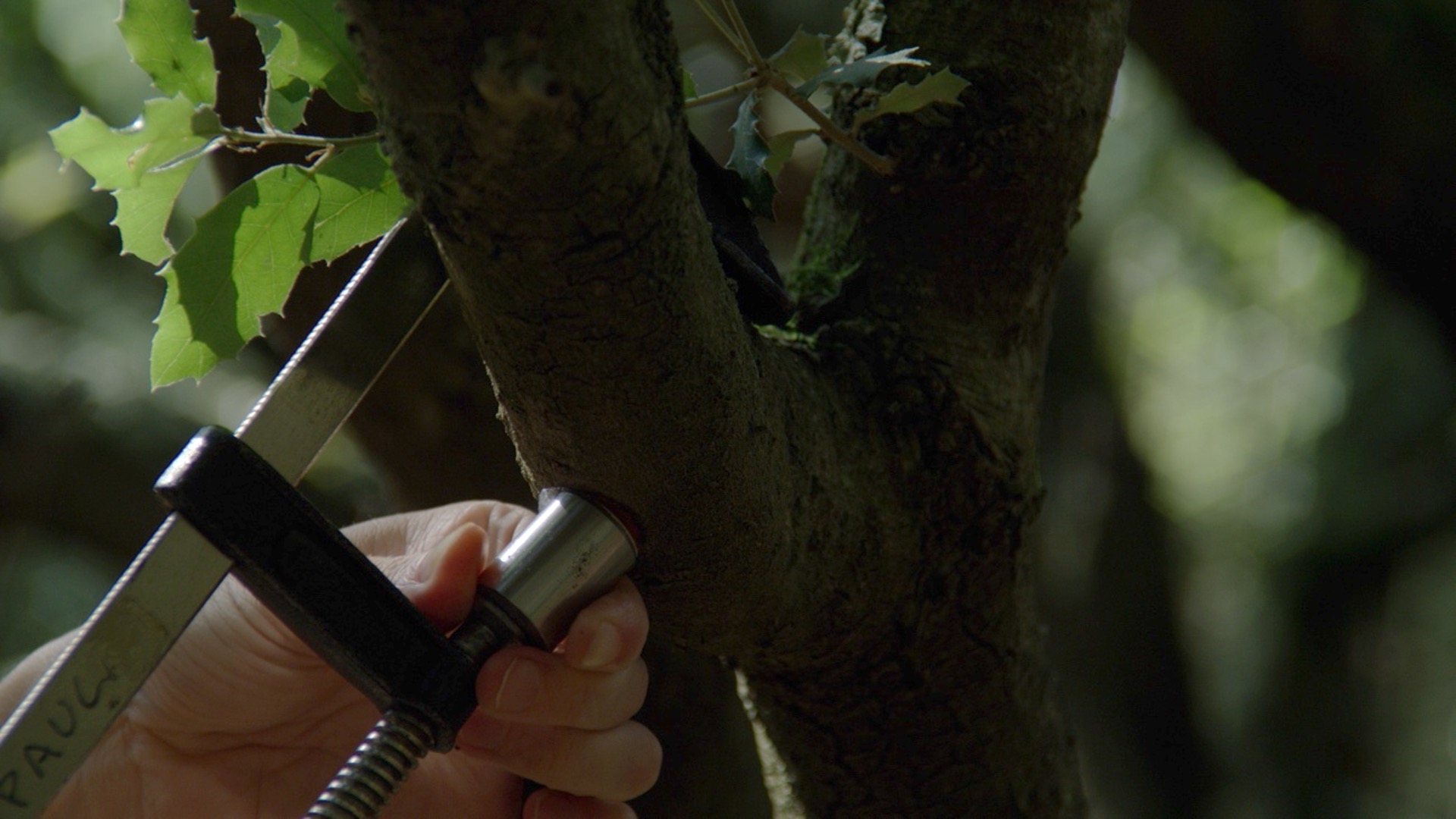
As part of this project, I developed the audiovisual installation “Embolismo por soleá. Diálogo en 12 tiempos”, which enabled me to understand what it is like to be a tree through its songs and accompany it through the contemporary flamenco of El Niño de Elche. Upon listening for months to a holm oak in the forest, I understood that a tree is a polyphonic being. Each branch has its own rate of embolism. The thinnest branches tend to embolize more, since in times of drought the tree prefers to secure water in the trunk and main branches. If things go bad, the rest can regenerate in better times. For the same reason, the rate of embolism is faster in damaged or diseased branches, almost like a bulería.
SOFOCO Residency
Given that “Embolismo por soleá” was originally a body of work centered around a single tree, my proposal for the SOFOCO residency was to work with the forest as an entity in which the sounds of shrubs and trees mix, creating a “forestal flamenco ensemble.” I wondered how a Mediterranean forest sounds to insects and other beings who are able to hear the sonic frequencies of the embolism.
The idea was to register the sounds of embolism of a Mediterranean forest in Madrid so as to hear what they have to say about these heated times. Nevertheless, the spring of 2025 was exceptionally rainy. Although the intense heat would eventually come, my residency months turned out not to be the most adequate to study the embolism in the forests of Madrid. I took advantage of this opportunity to run the necessary tests helping me understand the embolism of different Mediterranean species and test the hypothesis of the forest as a vegetal flamenco ensemble. Given that it was not suitable to head to the forest, I brought a small forest to our workspace with which I could test my methodologies.
Methodology
Five stone pines (Pinus pinea), two oak trees (Quercus robur), a beech tree (Fagus sylvatica), three ash trees (Fraxinus angustifolia), twelve rosemary shrubs (Rosmarinus officinalis) and an elm (Ulmus minor): a total of 23 plants from the nursery of the Higher Technical School of Mountains, Forestry and Natural Environment Engineering of the Polytechnic University of Madrid. Thanks to the collaboration with Dr. Rosana López Rodríguez (plant ecophysiologist, focused on Mediterranean forests), these species turned the space at the Institute for Postnatural Studies into a flamenco plant laboratory.
Using a machine that records the ultrasound of plant embolism and software that translates it into the audible range, I recorded the rhythms of the different plants in the indoor forest. Under the hypothesis of the forest as a "vegetal flamenco painting," I worked with dancer and philosopher Fernando López, whose career is characterized by a critical and transdisciplinary exploration of flamenco as a bodily, political, and poetic language. His approach challenges the traditional boundaries of the genre, proposing a flamenco that is sensitive to social and ecological contexts. Like a flamenco shaman, Fernando gave body and voice to the different rhythms, elucidating the flamenco personality of each species.
Findings
El jolgorio del pino - The pine revelry. Fernando danced the pine tree to bulería. His elongated body conversed with the straightness of the branches. The pine tree belongs to the gymnosperm group, whose wood is known as "softwood" because it is primarily composed of tracheids. That is, unlike angiosperms (flowering plants), conifers like the pine tree lack conducting vessels (tracheae) in their xylem, relying on tracheids for conduction and mechanical support. Thus, a pine tree has many very fine ducts, which explains its revelry in embolism.
El cante jondo del roble - The deep song of the oak. “If the pine sounds cheerful and cheeky, the oak sounds solemn and slow,” Fernando said, embodying an almost motionless dance, only accelerated by the embolic event that was slow to arrive. We agreed that it made sense. And I was fascinated that it made sense, because it hinted at the existence of an unconscious prior knowledge about the world.
Los romeros palmeros - The clapping rosemary shrubs. 12 was the number of rosemary plants which participated in the indoor forest; 12, the same number as the rhythm of the bulería, the soleá, and the alegría. Being an understory shrub, the rosemary seemed to us like a group of palmeros [clappers] accompanying the singing of the trees. Fernando responded to their clapping with the popular flamenco lyrics "Sueña la margarita con ser romero" (The Daisy Dreams of Being a Rosemary), and we wondered about the trans concept underlying this song. Respecting the plants’ primacy, Fernando sang haltingly, following the unmeasured rhythm they marked.
La jarana forestal - The forest jarana. All the layers of embolism from all the trees and shrubs in our forest sounding at once transformed the space into a forest jarana. Fernando's dance became energetic. His zapateaos [footwork] responded to the voices around us, sometimes unsyncopated, sometimes with astonishing synchronization.
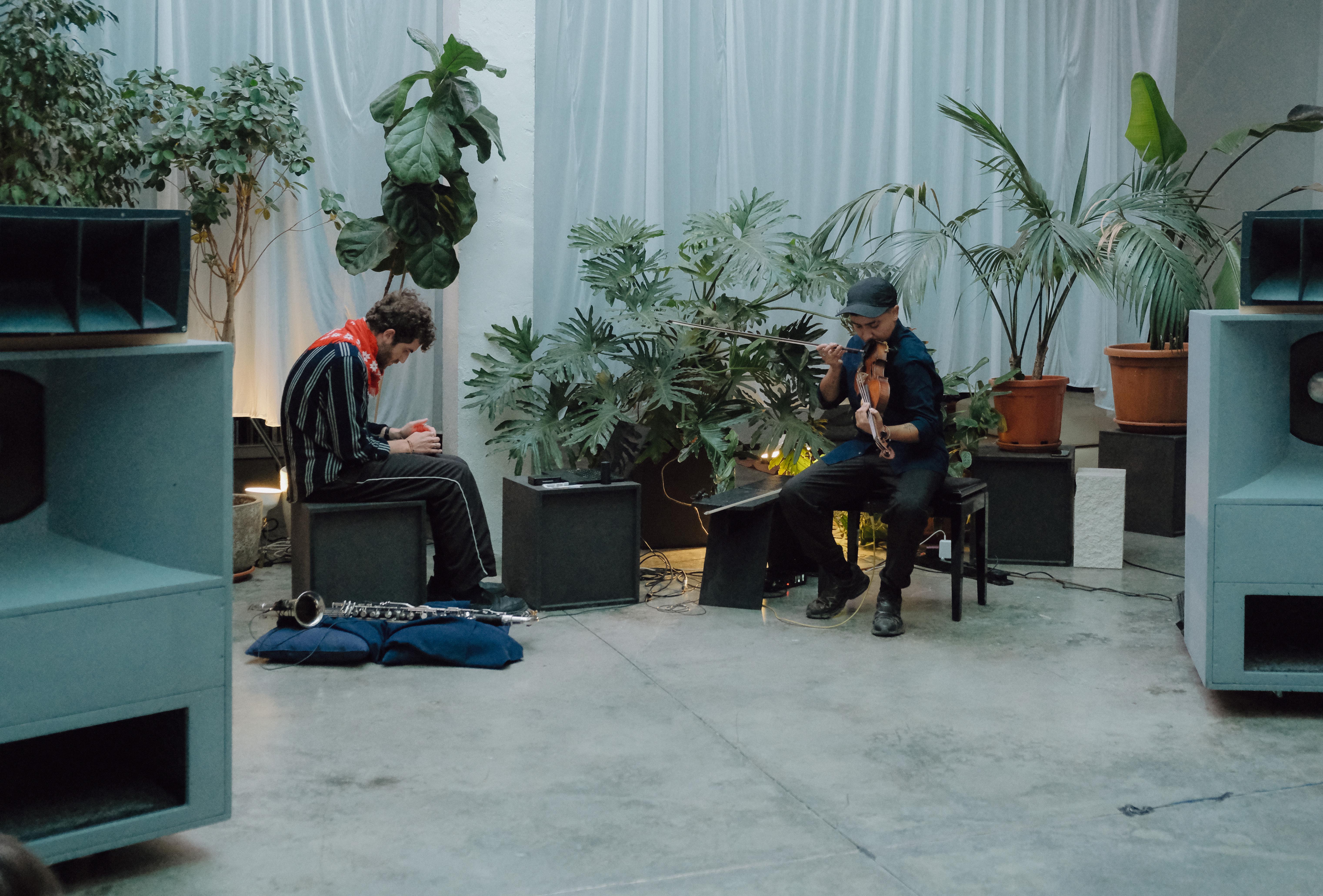
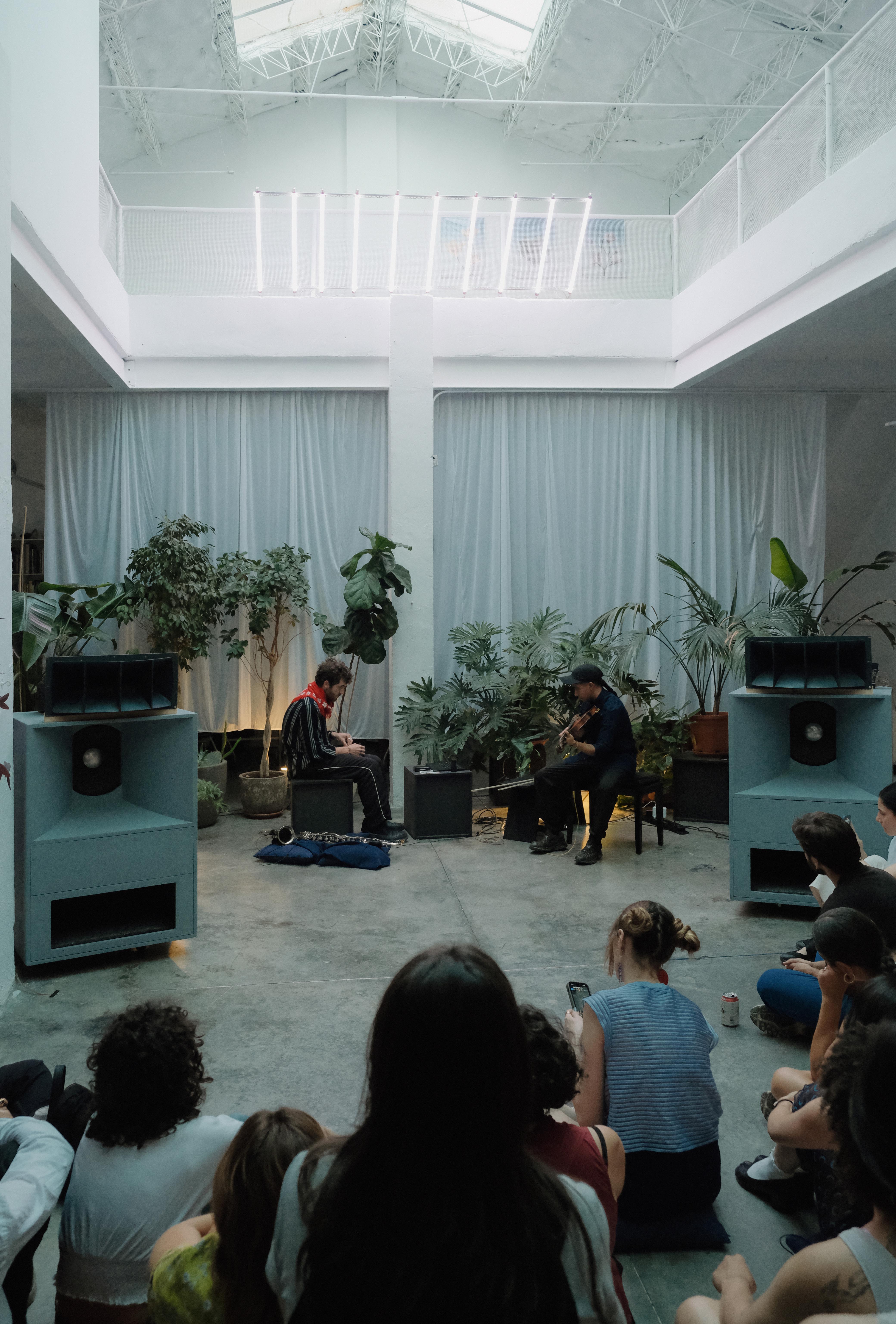
The lessons learned from this residency were shared in the performance talk "Jondo vegetal," with the participation of Fernando and all the plants that accompanied us in these exercises of listening and interpreting flamenco.
Conclusions
Interpreting embolism as a cante jondo [deep song] of the tree helps us approach vegetal subjectivity. Embolism is not only a physiological event, but also a sound expression of what the plant is going through. Listening to the tree’s quejíos [lamentations] is a way of delving into its experience; it is a way of feeling its aches and resistance. Science provides a layer of reasoned knowledge, but this, on its own, is limited. Emotion and intuition (or shared telluric knowledge) lead to empathy with the individual, which is crucial for deepening our knowledge and understanding of others.
Presumes que eres la ciencia,
yo no lo he entendío así,
ay, porque siendo tú la ciencia
no me has comprendío a mí
(Estrofa de la soleá popular Presumes que eres la ciencia)
You boast that you are science,
yet I haven’t understood it that way,
oh, for as you claim to be science,
You haven’t understood me
(Verse from the traditional soleá “Presumes que eres la ciencia” )
Note: In flamenco, “la ciencia” can poetically refer to knowledge, wisdom, or even rational understanding.
Dance is a form of embodied knowledge. The movement of the body that listens, that lets itself be affected, that translates without intervening, turns into a way of approaching the vegetal being without imposing. Flamenco, danced in listening to the tree, does not interpret or imitate; it accompanies. This form of research incorporates vulnerability as a means of understanding. Dancing with the forest is not about displaying knowledge, but rather following what the forest has to say. In this way, the dancer becomes a shaman who mediates between the plant and the human being, thus facilitating empathy and fostering a knowledge that does not come from the mind, but from the skin (what in flamenco is known as duende).
El conocimiento vino,
el co-noci-miento,
ay, porque agüita pasajera
no mueve ningún molino.
(Estrofa de la soleá popular Y de flores coronarte)
Understanding has come,
the un-der-standing
oh, because fleeting water
turns no mill.
(Verse from the traditional soleá “Y de flores coronarte”)
Flamenco once again proves itself a telluric language capable of understanding the rhythms of life and channeling its emotions. From its marginal origins, it has been a refuge for dispossessed bodies, for those left out of the dominant narrative. And what is a tree but a marginal peasant from the anthropocentric capitalist perspective? Thus, contemporary flamenco can give voice to beings ignored by the hegemonic system, such as forests and their inhabitants. In this way, flamenco becomes an emotional bridge between species; a political and ecopoetic tool that decenters the human gaze and celebrates nonhuman life through feeling and accompaniment between species.
Que nadie me vaya a llorar
el día en que yo me muera.
Es más bonito cantar
aunque se cante con pena.
(Estrofa de la bulería popular Que nadie me vaya a llorar)
May nobody mourn me
on the day I die.
It is best to sing
even if pain there lies.
(Verse from the traditional bulería “Que nadie me vaya a llorar”)
Acknowledgments:
To the Institute for Postnatural Studies for the trust placed in me, and to Daniel H. Rey for his support; to Fernando López for being such a wonderful flamenco shaman; to Rosana López for providing the plants and scientific advice, and for supporting me throughout the residency; to the participants in the critique session, to Lorenzo Sandoval and Paula Comitre for their contributions to the project; to the 23 plants that were part of this essay; to those who attended the Jondo Vegetal event, and especially to those who adopted one of the members of the "vegetal flamenco ensemble."
The project 'Embolismo por soleá' and all its stages of work, ramifications, and collaborations are the work of Paula Bruna and must be credited as such. The work hereby shared may not be used or distributed in its entirety or partially without rightful crediting to the artist and seeking her consent in writing.
ARTIST BIO
-
PAULA BRUNA

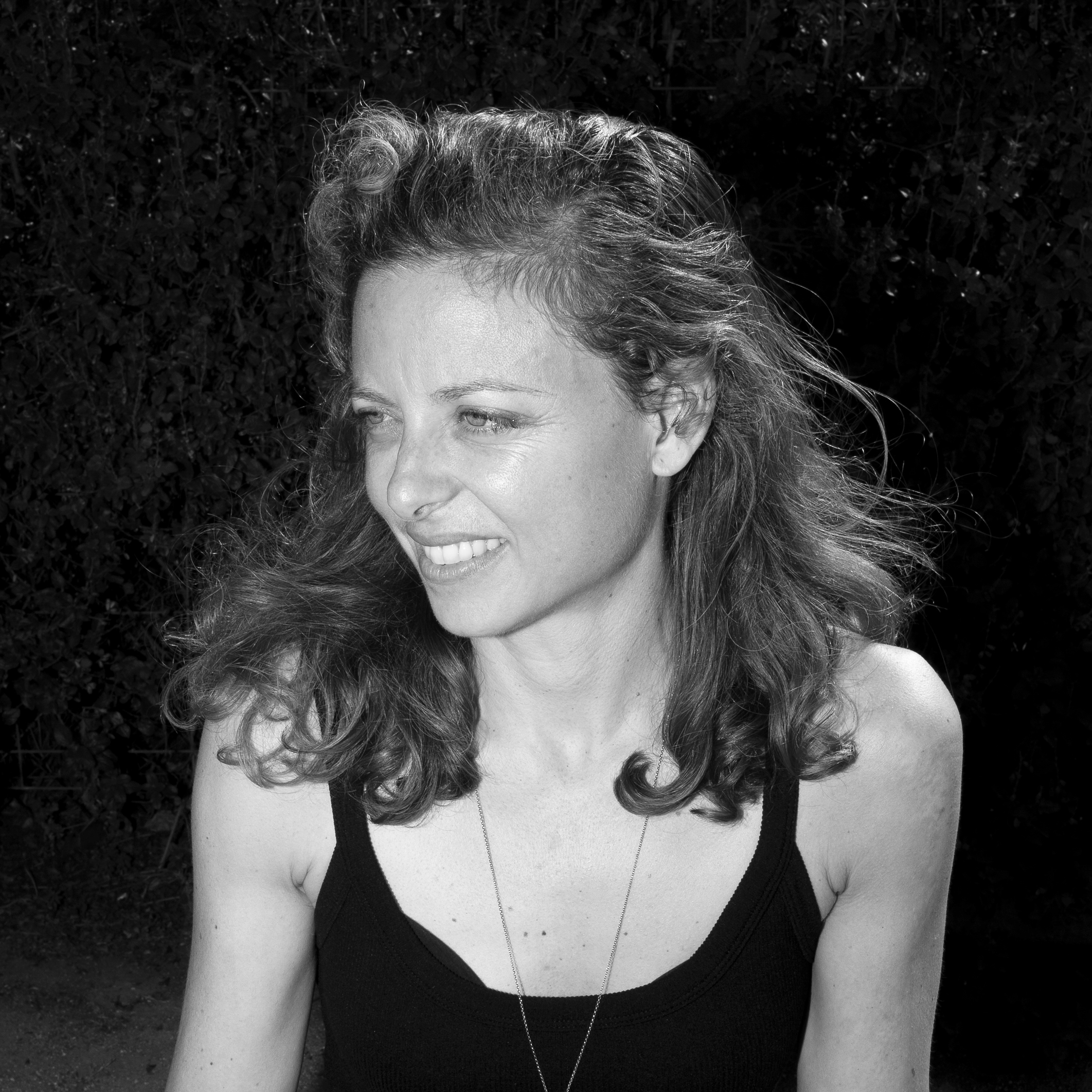
Paula Bruna (Barcelona, 1978) is a Spanish artist and environmentalist. Both professions have converged in her artistic projects, in which she works on alternative narratives to the Anthropocene from non-human points of view, through a combination of science facts, speculative fiction and artistic practices. Her hypothesis is that exploring points of view other than the actual anthropocentrism has significant effects on ecological awareness and opens up the range of possible ways of cohabitation. Paula holds a PhD in Fine Arts at the University of Barcelona with a thesis on art and political ecology. She shares her research and artwork in national and international congresses, publications, workshops, artistic events and exhibitions. Her artistic research has been awarded with several Catalan grants. She has stayed at national and international artist residencies, with particular interest in those with ecological approaches.
CREDITS
- NATIONAL JURY
-
ISLA - Ideario de Sostenibilidad, Laboratorio de Arte
- SUPPORTED BY
-
City of Madrid - Government of Area for Tourism, Culture and Sports